

ICQE26 Workshops | Tuesday, Nov 10, 2026:
Morning Workshops:
1A: Introduction to Epistemic Network Analysis (ENA)
Facilitators: Andrew Ruis, Adaurennaya Onyewuenyi, Brendan Eagan, Jun Oshima
This workshop introduces participants to the fundamentals of Epistemic Network Analysis (ENA), with a focus on understanding the conceptual foundations and practical applications of ENA models. The goal of the workshop is to help participants independently use the ENA Web Tool to build, explore, and interpret ENA models.
The workshop consists of three parts: (1) conceptual foundations, (2) hands-on tutorial, and (3) guided exploration. In the first part, participants will learn about the key parameters and assumptions underlying ENA models, including how modeling decisions shape the resulting network representations. The second part provides a step-by-step introduction to the ENA Web Tool, demonstrating how to prepare data, construct models, and interpret ENA visualizations and statistical outputs. In the final part, participants will explore the tool's functions through practical activities and discussion.
A demonstration dataset will be provided for all workshop activities. Participants are also encouraged to bring their own coded datasets if they would like to experiment with applying ENA to their own research contexts.

1B: Advanced Epistemic Network Analysis
Facilitators: Zachari Swiecki, Yuanru Tan, David Williamson Shaffer
This workshop is designed for participants who have made ENA models and are looking to (a) understand more of the mathematics behind ENA, (b) learn more about advanced techniques in QE network analysis. Topics covered will include: creation of adjacency matrices, matrix accumulation, spherical normalization, dimensional reduction, and positioning network nodes, ordered and multimodal models, weighted models, model projection, and network trajectories. Participants will have an opportunity to try these techniques on their own data, or use the data present in worked examples during the workshop.
1C: Modeling Complex Learning Interactions with HINA: A Hands-on Workshop on Heterogeneous Interaction Network Analysis
Facilitators: Shihui Feng, Baiyue He, Alec Kirkley, Dragan Gasevic
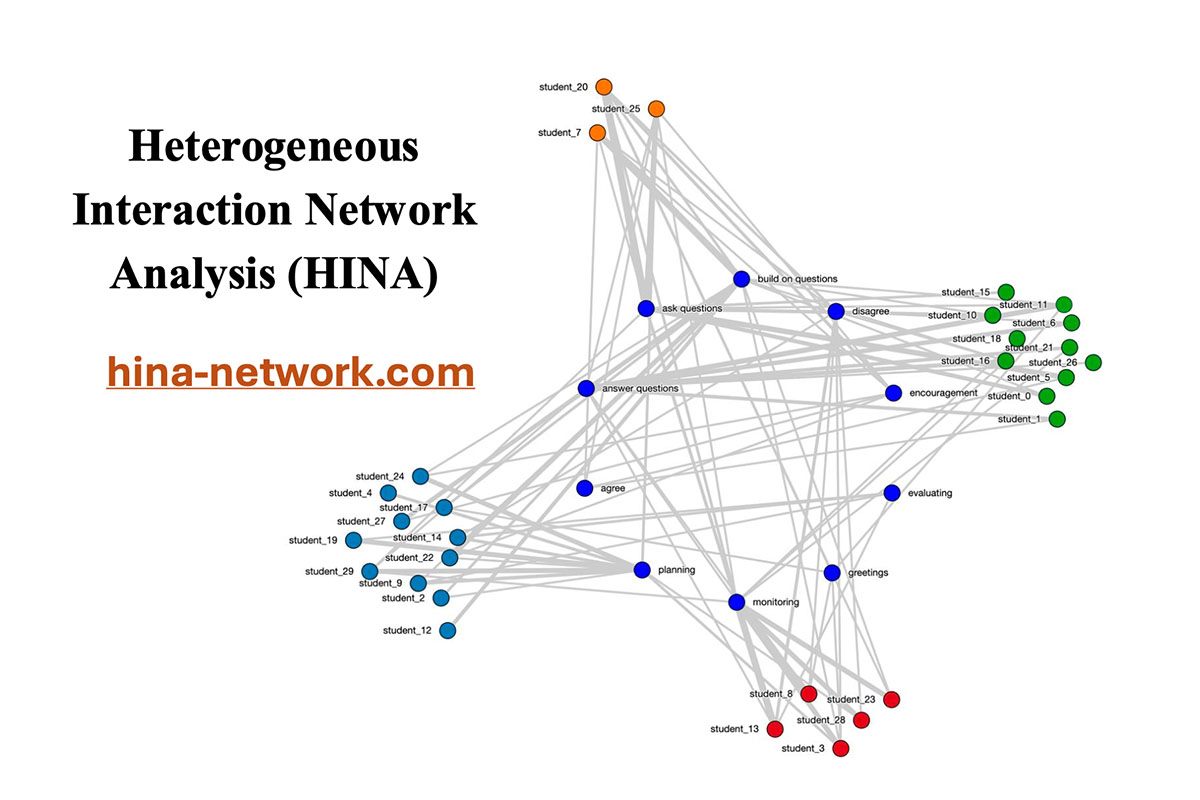
This workshop introduces HINA (Heterogeneous Interaction Network Analysis), a novel, open-source analytical framework designed to capture the heterogeneous, multi-entity nature of interactions in contemporary learning environments. Grounded in network science and guided by social constructivism learning theory, HINA formalizes multi-entity learning interactions as Heterogeneous Interaction Networks (HINs), where nodes represent distinct entity types—such as students, coded behaviors, subtasks, or AI agents—and edges encode relationships such as engagement or co-occurrence. HINA provides three levels of original analytical methods: (1) node-level measures of interaction quantity and diversity; (2) dyadic-level statistical testing for significant edges using configurable null models; and (3) meso-level, non-parametric clustering of nodes by interaction patterns. This workshop covers HINA's methodological foundations and includes a hands-on tutorial using the HINA web tool (hina-network.com) for analysis and interactive visualization.
This workshop is designed for a broad audience within the QE community, particularly researchers who work with learning process data (e.g., log files, behavioral codes, multimodal traces, AI interaction records) and seek new analytical methods to model complex, multi-entity interactions.
No prior experience with network analysis or programming is required. Participants are encouraged to bring their own datasets, though curated sample datasets will be provided.
Participants will leave with both practical skills and a deeper understanding of how HINA can expand the methodological repertoire of quantitative ethnographers, enabling them to ask new questions about the distributed, multi-faceted nature of learning interactions in contemporary educational environments.
Contact: Shihui Feng, shihuife@hku.hk
1D: Open-Source Tools for Transcribing and Coding Multimodal Qualitative Data: An Interactive Tutorial
Facilitators: Kirk Vanacore, Bakhtawar Ahtisham, Zhuqian Zhou, Daryl Hedley, Doug Pietrzak, Joshua Marland, Rachel Slama, and René Kizilcec
This tutorial introduces open-source workflows for transcribing and coding multimodal qualitative data for Quantitative Ethnography (QE). QE researchers often work with rich discourse data, including interviews, conversations, observations, online discussions, screen recordings, audio, video, and interaction logs. These data make it possible to study meaning-making, participation, collaboration, identity, expertise, and institutional practice at scale, but they also create methodological challenges. Multimodal interactions must be transformed into analyzable representations, and qualitative coding workflows must remain valid, transparent, and grounded in human interpretation.
Participants will learn how to use multimodal transcription workflows and Sandpiper, an AI-assisted coding system that orchestrates multiple models to support scalable qualitative analysis while preserving human review and researcher control. The tutorial will combine short methodological overviews, live demonstrations, and hands-on coding activities using sample data. By the end of the session, participants will understand how to move from raw video, audio, screen, and dialogue data to structured transcripts, coding tasks, AI-assisted coding outputs, and validation artifacts suitable for downstream quantitative ethnographic analysis.
Afternoon Workshops:
2A: Learning SCAT as a Qualitative Data Analysis Method: A Hands-on Workshop from Coding to Theory Writing
Facilitators: Takashi Otani, Daisuke Kaneko
This hands-on workshop introduces SCAT (Steps for Coding and Theorization) as a qualitative data analysis method. SCAT is an explicit, formal, and procedural method in which analysts segment qualitative text, conduct four-step coding, write storylines, and generate theoretical statements through theory writing.
The workshop is intended for researchers who are interested in the qualitative dimensions of Quantitative Ethnography (QE), as well as researchers who have encountered SCAT in previous ICQE presentations and would like to learn more about it. In QE, codes play an important role in connecting qualitative data with quantitative modeling. For this reason, understanding how qualitative codes are produced in interpretive qualitative data analysis can help researchers reflect on the methodological foundations of coding.
Participants will learn the basic principles and procedures of SCAT and apply them to a short simulated dataset. They will work through the process from segmentation and four-step coding to writing storylines and theoretical statements. Through this experience, participants will gain practical experience of interpretive qualitative data analysis and consider how SCAT could be used in their own research.
The workshop also clarifies that SCAT is not merely a code-generation tool for QE. In SCAT, codes and storylines are intermediate products, and the primary purpose is theory writing.
The official SCAT website is currently being restructured. Interim materials are available at: https://note.com/scatty
2B: A Workshop on Writing in Quantitative Ethnography
Facilitators: Zachari Swiecki, David Williamson Shaffer
Quantitative Ethnography (QE) integrates qualitative and quantitative evidence to support grounded claims about data and its context. Writing up QE work is non-trivial: authors must combine the conventions of qualitative reporting, the conventions of quantitative reporting, and a set of practices specific to QE itself, all in service of a single coherent argument. This three-hour workshop walks participants through each section of a QE paper in turn, pairing short talks on conventions with hands-on drafting activities. It is aimed at graduate students and early-career researchers, though open to anyone curious about QE writing. Participants will leave with a clearer mental model of the QE writing genre, new peer connections, and feedback from facilitators. A post-workshop writing group will extend the conversations and relationships beyond the conference itself.
2C: DIY QE: Demonstrating, Building, and Sustaining Community-Developed Tools for Quantitative Ethnography
Facilitators: Golnaz Arastoopour Irgens, Amanda Barany, Luc Paquette, Andrew Ruis, Yuanru Tan, Zhiqiang Cai
This interactive workshop responds to a growing challenge within the Quantitative Ethnography (QE) community: while researchers continue to develop innovative tools that extend QE processes, these tools remain scattered across personal repositories, labs, and informal collaborations with little shared infrastructure for dissemination, validation, or stewardship. Developments in AI and large language models have also accelerated tool creation, which offer possibilities for coding, analysis, and data collection while raising important questions about validity, transparency, reproducibility, and alignment with QE’s epistemological commitments. Through demonstrations, collaborative design activities, and community discussion, participants will explore emerging QE tools, begin planning or prototyping tools of their own, and contribute to conversations about how the community can collectively organize and sustain open methods infrastructure for QE practice.
2D: Introduction to Teaching QE
Facilitators: Ayano Ohsaki, Brendan Eagan, Zhichun Liu, Amalia Daché, Yujeong Cho, Amanda Barany
This is the second workshop in the series introducing education in Quantitative Ethnography (QE), organized by Teaching (with) QE, a Special Interest Group of the International Society for Quantitative Ethnography (ISQE). This year's focus is on teaching QE in a range of contexts, including practitioner-oriented courses, newly developed undergraduate courses, and QE modules as part of broader methods courses. During the first half of the workshop, presenting educators will share their approaches, challenges, and best practices for teaching QE. In the second half, participants will explore practical strategies for designing and teaching QE in their own contexts. The workshop is intended for researchers and practitioners currently engaged in QE education, individuals contemplating the integration of QE into their teaching, and learners aiming to deepen their understanding of QE pedagogy. If you are interested in brainstorming how to use QE in your formal and informal teaching, learning, or research, join us!